


What Is Medical Device Packaging and Why Does Sterile Integrity Matter?
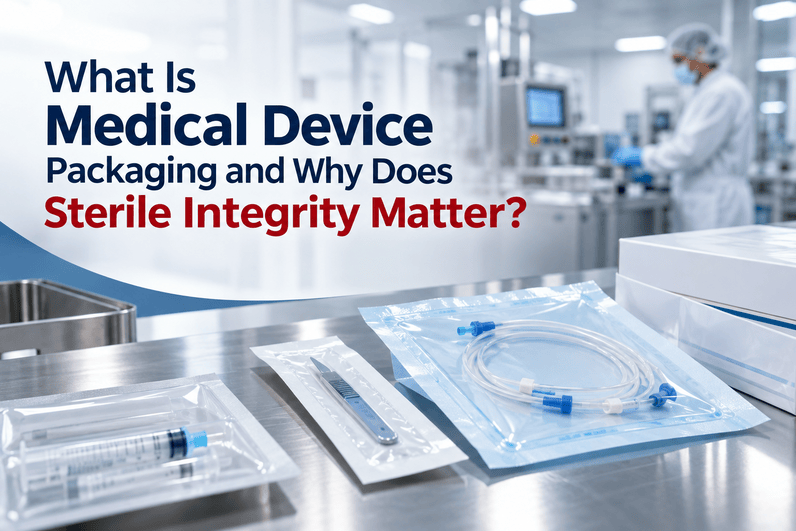
Medical devices leave the production line in a carefully controlled condition. Once they enter distribution and storage, the package becomes their primary protection against physical damage, environmental exposure, and, for sterile products, microbial contamination. Without reliable packaging, that protection can fail long before the device reaches the clinician or patient.
Medical device packaging is the combination of materials, package design, and processes used to contain, protect, and present devices such as syringes, catheters, surgical instruments, swabs, gauze, and diagnostic kits. When the product is supplied sterile, the package must also function as a sterile barrier system that maintains integrity until it is opened under appropriate conditions. Medical device packaging machines support these requirements by providing controlled placement, consistent sealing, and process monitoring that help the finished package perform as intended.
The package is not just a container. For many medical devices it is the final line of protection between production and the point of use.
Industry Snapshot
Industry analyses describe continued focus on packaging systems that support sterile barrier performance, process consistency, and documentation for medical devices. Equipment and materials are selected to match product characteristics, sterilization methods where applicable, and the stresses of handling, storage, and distribution.
What Is Medical Device Packaging?
Medical device packaging is the system of materials, package formats, and processes designed to protect a medical device from physical damage, environmental factors, and contamination from the end of manufacturing until the point of use. It includes primary packaging that contacts or directly encloses the device, secondary packaging that provides additional protection or grouping, and the processes used to form, fill, seal, inspect, and label those packages.
Unlike general consumer packaging, medical device packaging often must meet specific performance requirements related to barrier properties, seal strength, compatibility with sterilization, and the ability to present the device aseptically when opened. Package formats commonly include peelable pouches, rigid or semi-rigid trays with lids, header bags, and multi-compartment kits. The choice depends on the device’s size, shape, fragility, and whether it is supplied sterile. Packaging is therefore both a protective system and a functional part of the overall product.
Why Does Sterile Integrity Matter?
Sterile integrity is the ability of the packaging system to maintain a microbial barrier so that a device supplied sterile remains in that condition until the package is opened correctly. Loss of integrity can allow contamination that compromises patient safety and product performance.
When a sterile barrier fails, the device may no longer be suitable for its intended use. This can lead to rejected product, investigations, potential recalls, and risk to patients. Sterile integrity therefore protects clinical outcomes as well as regulatory compliance and commercial reliability. Maintaining it requires attention to materials, sealing processes, handling, and the entire distribution chain.
Key reasons sterile integrity is critical include:
- Patient Safety: A compromised barrier can introduce microorganisms that increase infection risk during clinical use.
- Product Performance: Contamination or moisture ingress can affect the physical or functional properties of certain devices.
- Regulatory and Quality Expectations: Packaging processes and materials are expected to support the claimed sterile condition through the labeled shelf life.
- Supply Chain Reliability: Packages must withstand handling, shipping, and storage without losing barrier performance.
- Aseptic Presentation: The package must allow the device to be removed in a controlled manner that preserves sterility at the point of use.
- Economic Impact: Failures can result in scrap, rework, complaints, and loss of confidence in the product.
These factors make sterile integrity a core performance requirement rather than an optional feature.
How Do Packaging Materials Support Sterile Integrity?
Packaging materials form the physical barrier that helps maintain sterile integrity. Their selection and performance directly influence whether the package can protect the device under expected conditions.
Barrier Properties
Materials are chosen for their ability to resist the passage of microorganisms and, where required, moisture or gases. Common options include coated papers, plastic films, and multilayer laminates that may incorporate foil or specialized polymer layers. The material must maintain these properties after sterilization and throughout the shelf life.
Compatibility with Sterilization
Many medical devices are sterilized after packaging. Materials must withstand the chosen sterilization method—such as ethylene oxide, radiation, or steam—without degradation that would create channels or weaken seals. Compatibility testing confirms that barrier performance remains acceptable after the process.
Mechanical Strength and Durability
The package must resist puncture, abrasion, and flexing during handling and distribution. Weak materials can develop holes or stress cracks that compromise the barrier even if the original seal was sound.
Sealability and Peel Performance
Materials must form consistent, reliable seals under defined process conditions while still allowing controlled opening at the point of use. Peelable seals are often preferred so that the package can be opened without generating excessive particles or requiring instruments that might compromise asepsis.
Material selection therefore balances barrier performance, process compatibility, strength, and usability.
How Do Sealing Processes Create and Maintain the Barrier?
The seal is the continuous joint that closes the package and completes the sterile barrier. Automated sealing processes apply controlled heat, pressure, and time to fuse or bond the packaging materials.
Consistent application of validated sealing parameters produces uniform seals across successive packages. Any variation in temperature, pressure, dwell time, or material condition can create weak spots, channels, or incomplete bonds. Seal-area cleanliness is equally important: fibers, powder, or device components that enter the seal zone can prevent proper bonding.
Practical sealing considerations include:
- Validated Process Parameters: Temperature, pressure, and time are established for the specific materials and verified to produce acceptable seals.
- Uniform Application: Automated systems help apply the same conditions to every package, reducing operator-to-operator variation.
- Seal-Area Management: Product placement and handling methods keep the sealing surfaces free of interference.
- In-Process Monitoring: Sensors or process data can detect deviations that might affect seal quality.
- Material Consistency: Changes in film or tray lots are evaluated to confirm that sealing performance remains within limits.
- Post-Seal Protection: Handling after sealing avoids stressing or damaging the newly formed seal.
When these elements are controlled, the sealing step reliably completes the sterile barrier.
How Does Product Handling Influence Package Integrity?
Product handling before, during, and after packaging can affect sterile integrity even when materials and seals are correct. Rough transfer can generate particles or damage packaging materials. Incorrect placement can leave device components in the seal zone, creating potential channels. After sealing, excessive force or poor secondary packaging can puncture or stress the primary package.
Handling systems are designed around the specific characteristics of each device. Rigid items such as syringes need secure orientation. Soft or fibrous materials such as swabs and gauze require gentle transfer that limits fiber shedding and compression. Multi-component kits need accurate positioning so that every item remains clear of the seal area. Downstream conveyors, cartoning, and palletizing must protect the finished packages from mechanical damage. Careful handling therefore preserves the integrity that materials and sealing have created.
What Role Do Medical Device Packaging Machines Play?
Medical device packaging machines automate the steps of forming or presenting the package, placing the device, sealing, and often inspecting the result. Automation improves consistency compared with purely manual processes and reduces the opportunity for human error in critical steps.
Machines can be configured for pouch packaging, tray sealing, or hybrid systems depending on the device and package format. Controlled motion profiles limit mechanical stress on delicate items. Integrated sensors or vision systems verify presence, orientation, and selected seal attributes. Process data can be recorded for review and documentation. A flexible packaging machine adapted for medical use may form pouches from roll stock, while other systems handle premade pouches or rigid trays. In every case the machine is selected and validated to support the specific protection and integrity requirements of the product.
Supporting capabilities include:
- Precise Product Placement: Mechanisms that orient and locate devices so that seal zones remain clear.
- Consistent Sealing Control: Closed-loop management of temperature, pressure, and time.
- Inspection Integration: Checks for missing components, incorrect placement, or visible seal defects.
- Environmental Compatibility: Designs suitable for controlled or cleanroom environments.
- Data Capture: Recording of process parameters that support quality systems and troubleshooting.
- Cleanable Construction: Surfaces and access points that facilitate effective cleaning between batches or products.
These features help the packaging process deliver packages that maintain sterile integrity under defined conditions.
How Is Sterile Integrity Verified and Maintained Over Time?
Verification and ongoing control confirm that the packaging system continues to perform as intended after initial validation.
Process Validation
Validation demonstrates that the packaging process, when operated within established parameters, consistently produces packages that meet defined integrity and performance requirements. It typically includes evaluation of materials, machine settings, environmental conditions, and handling methods.
In-Process and Release Checks
During production, selected attributes such as seal appearance, component presence, and critical process parameters are monitored. Finished packages may undergo integrity testing according to the manufacturer’s quality plan. These checks help detect issues before large quantities of product are affected.
Change Control and Stability
Changes to materials, equipment, or process settings are assessed for impact on sterile integrity. Stability studies evaluate package performance over the claimed shelf life under defined storage conditions. Distribution simulation can identify stresses that might compromise the barrier.
Documentation and Traceability
Records of materials, process parameters, and inspection results support traceability and provide evidence that the process remains under control. This documentation is essential for quality systems and regulatory expectations.
Ongoing verification therefore extends sterile integrity assurance beyond the initial packaging step.
How Do Storage, Distribution, and End Use Affect Integrity?
A package that leaves the production line with intact sterile integrity can still fail if it is damaged during storage, shipping, or handling at the point of use. Temperature cycling, high humidity, stacking pressure, vibration, and impact can stress materials and seals. Secondary packaging and pallet configurations are designed to mitigate these risks.
At the clinical site, packages must be stored according to labeled conditions and opened using techniques that preserve asepsis. Packaging design that supports clean peeling or controlled opening reduces the chance of contamination during presentation. Coordination across the supply chain—from packaging engineering through logistics to end-user instructions—helps ensure that the sterile barrier remains effective until the device is ready for use.
What Factors Should Manufacturers Consider When Designing Packaging Systems?
Designing a packaging system that supports sterile integrity requires evaluation of the device, the intended protection level, and the full lifecycle of the package.
Important factors include:
- Device Characteristics: Size, shape, fragility, and any sensitivity to moisture or mechanical stress determine package format and handling methods.
- Sterilization Method: Compatibility of materials and seals with the chosen sterilization process is essential when the device is supplied sterile.
- Barrier and Shelf-Life Requirements: Expected storage duration and environmental conditions guide material selection and package design.
- Production Volume and Automation Level: Throughput needs and available processes influence whether manual, semi-automated, or fully automated systems are appropriate.
- Inspection and Documentation Needs: Quality system requirements determine the level of in-process checks and data capture.
- Distribution Stresses: Anticipated handling, shipping, and storage conditions shape secondary packaging and overall robustness.
- Usability at Point of Use: The package must allow safe, controlled opening and aseptic presentation in the clinical environment.
Addressing these factors early reduces the risk of later failures and supports a packaging system that performs reliably in practice.
What Should Teams Evaluate When Implementing Packaging Processes?
Implementing a packaging process that maintains sterile integrity begins with clear definition of product requirements, package performance criteria, and process conditions. Teams should confirm that materials, equipment, and procedures are capable of meeting those criteria under realistic operating conditions.
Equipment selection should consider product handling needs, sealing requirements, cleanability, integration with upstream and downstream steps, and the ability to capture process data. Validation confirms consistent performance within defined limits. Ongoing monitoring, change control, and periodic review keep the process in a controlled state. Early trials with actual devices and packaging materials under representative conditions often reveal adjustments needed for robust performance. Treating packaging as a complete system—materials, machine, environment, handling, and distribution—provides a stronger foundation for sterile integrity than focusing on any single element.
Illustrative Packaging Performance Example
A manufacturer of sterile single-use instruments evaluated a transition from manual pouch sealing to an automated system with controlled placement, validated sealing parameters, and in-process inspection. In this illustrative scenario, the focus was on keeping seal areas free of device interference, maintaining consistent sealing conditions across material lots, verifying package attributes before release, and protecting finished packages during secondary packaging and distribution. Process trials helped refine placement tooling, sealing settings, and handling methods. The example illustrates how systematic attention to materials, machine control, and lifecycle stresses can support more reliable sterile integrity from packaging through use.
Comparison Table of Elements Supporting Sterile Integrity
|
Element |
Contribution to Integrity |
Key Control Focus |
|
Packaging Materials |
Provide the physical microbial barrier |
Barrier properties, sterilization compatibility |
|
Sealing Process |
Completes the continuous closure |
Validated parameters, seal-area cleanliness |
|
Product Handling |
Prevents damage and seal-zone interference |
Gentle transfer, accurate placement |
|
Equipment and Automation |
Delivers consistent process execution |
Placement control, sealing stability, inspection |
|
Verification and Monitoring |
Confirms ongoing performance |
Validation, in-process checks, documentation |
|
Storage and Distribution |
Preserves integrity after packaging |
Secondary packaging, environmental controls |
Frequently Asked Questions
What is the main purpose of medical device packaging?
It protects the device from physical damage, environmental exposure, and contamination, and, for sterile products, maintains a microbial barrier until the package is opened correctly.
Why is sterile integrity especially important?
Loss of integrity can allow contamination that affects patient safety, product performance, and compliance with quality and regulatory expectations.
How do packaging materials contribute to sterile integrity?
They form the physical barrier and must provide appropriate microbial resistance, withstand sterilization where used, and maintain performance during handling and storage.
What role do medical device packaging machines play?
They automate placement, sealing, and inspection steps with controlled parameters that support consistent package formation and reduce variation compared with manual processes.
What should manufacturers evaluate when designing packaging systems?
Device characteristics, sterilization compatibility, barrier requirements, production needs, inspection and documentation expectations, distribution stresses, and usability at the point of use.
Wrapping Up
Medical device packaging is the system of materials, designs, and processes that protect devices from production through to clinical use. Sterile integrity is the ability of that system to maintain a microbial barrier for products supplied sterile. It matters because failure can compromise patient safety, product performance, and supply-chain reliability.
Materials provide the barrier, sealing completes it, handling preserves it, and equipment such as medical device packaging machines and flexible packaging systems execute the process with consistency. Verification, monitoring, and attention to storage and distribution extend protection across the product lifecycle. When these elements are selected and controlled as an integrated system, packaging supports the safe and effective use of medical devices.
Sterile integrity is maintained not by any single feature, but by the disciplined combination of materials, process, and protection from the packaging line to the point of use.

eSIMcho | Global eSIM & No Roaming

 Български
 English