


Why We Stay in Comfortable Unhappiness
Why We Stay in Comfortable Unhappiness
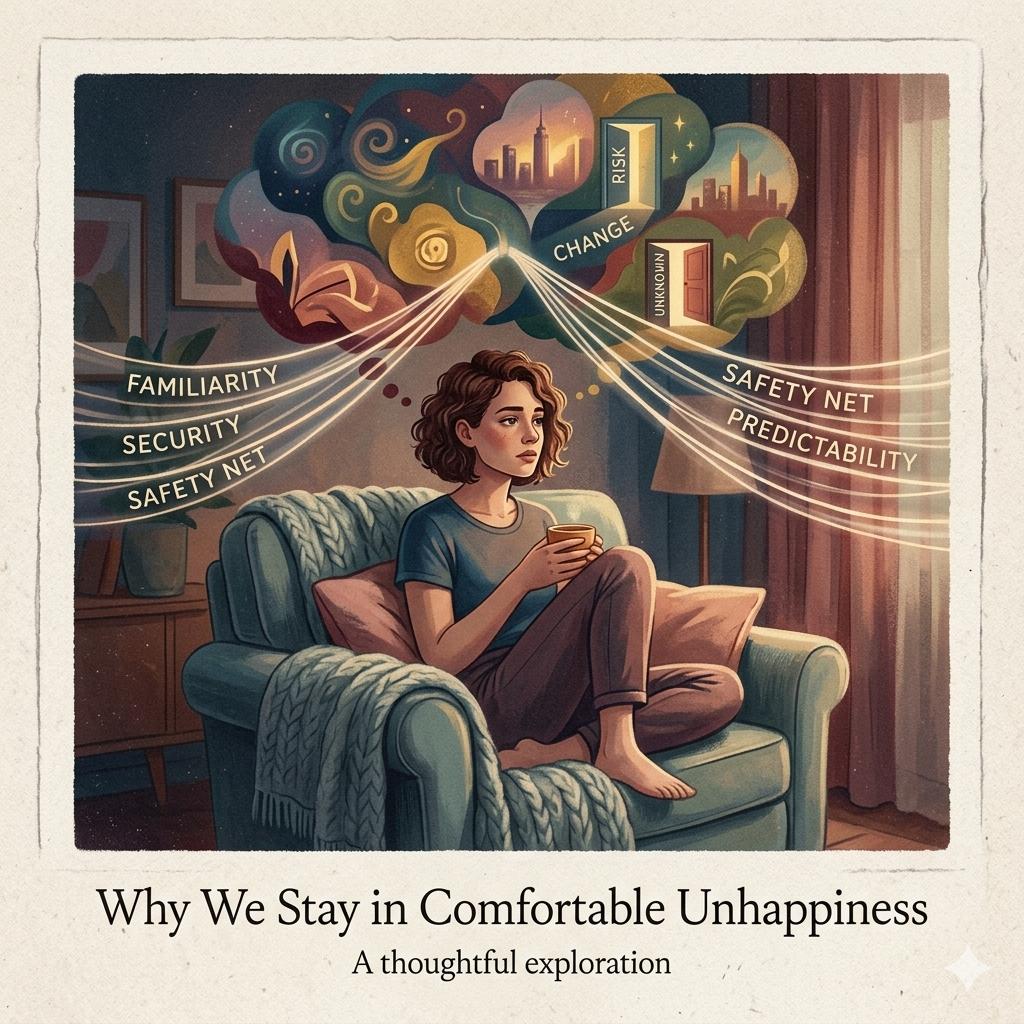
Sometimes, unhappiness may not feel painful enough to inspire change. Familiar routines, relationships, jobs, or thought patterns can provide comfort despite lacking satisfaction. Comfortable unhappiness may develop through fear of uncertainty, low confidence, emotional habits, or perceived obligations. Recognising these patterns can help explain why familiarity may feel safer than change.
What Does Comfortable Unhappiness Mean?
Comfortable unhappiness means staying in unsatisfying circumstances because they feel familiar and predictable. Someone may remain in an unwanted job, relationship, or routine because change, uncertainty, or possible failure feels more uncomfortable. This creates a conflict between immediate emotional safety and long-term fulfilment.
Why Familiar Patterns Can Feel Safer
People often prefer familiar routines because they reduce uncertainty, even when those routines are unpleasant. Repeated behaviours can become automatic through learning and reinforcement (Wood & Rünger, 2016). Fear of making the wrong decision may also lead people to postpone changes, allowing hesitation to become a familiar pattern.
The Role of Fear and Avoidance
Avoidance can temporarily reduce emotional discomfort while maintaining the underlying problem. Someone who feels dissatisfied may distract themselves with work, entertainment, social activities, or constant responsibilities rather than examining what is causing the dissatisfaction.
This can contribute to handling daily pressures, particularly when unresolved concerns accumulate over time. Emotional avoidance may also increase emotional worry management difficulties because uncertainty remains unresolved rather than being addressed.
Avoidance does not always appear obvious. It can look like overthinking, excessive planning, constantly staying busy, repeatedly seeking reassurance, or telling oneself that change can happen “later.”
When Self-Doubt Keeps the Pattern Going
Low confidence can make an unsatisfying situation appear easier to tolerate. A person may believe they lack the ability to create something different or worry that their circumstances cannot improve.
This is where personal growth and development become important. Growth does not necessarily require making dramatic changes immediately. It may begin with recognising personal needs, identifying values, questioning limiting beliefs, and taking manageable steps toward meaningful change.
Small actions can also provide evidence that change is possible. For instance, expressing an opinion, exploring a new activity, updating professional skills, or having an honest conversation may gradually strengthen confidence.
How Emotional Habits Influence Decision-Making
Emotions can strongly influence how people interpret situations and make decisions. When dissatisfaction continues for a long period, frustration may become part of everyday life. Some individuals may experience anger regulation strategies as an ongoing challenge when they feel trapped, unheard, or unable to change their circumstances.
Others may respond by withdrawing, suppressing feelings, or becoming emotionally detached. Neither reaction necessarily addresses the underlying issue.
Developing emotional response regulation can help individuals notice feelings without immediately acting on them. Emotional awareness creates space to ask useful questions: What exactly feels unsatisfying? What am I afraid will happen if I change it? What do I actually want instead?
Recognising the Cost of Staying the Same
Remaining in an unsatisfying situation may initially seem easier, but prolonged dissatisfaction can affect different areas of functioning. Persistent emotional strain may interfere with concentration, relationships, motivation, and physical well-being.
For some people, disrupted sleep may become part of the pattern. Repeatedly thinking about unresolved problems at night can make it difficult to relax, while poor rest can make emotional challenges feel harder to manage the following day.
The goal is not to assume that every uncomfortable situation requires immediate change. Some circumstances involve responsibilities, financial limitations, family considerations, or other practical realities. Instead, recognising the cost of remaining unchanged can help a person make more deliberate decisions.
Moving From Familiarity Toward Meaningful Change
Change becomes more manageable when it is approached gradually rather than as an all-or-nothing decision. Defining meaningful personal targets can provide direction without creating unrealistic expectations.
A person might begin by identifying one area of life that feels consistently unsatisfying. Writing down concerns, identifying personal values, discussing options with someone trustworthy, and considering realistic alternatives can make the situation clearer.
Practising mindful awareness techniques can also help individuals observe thoughts and emotions without immediately judging them. Mindful awareness may create greater space between an emotional reaction and a behavioural response. The purpose is not to eliminate uncertainty. It is to become more capable of making choices despite uncertainty.
Breaking the Cycle Without Forcing Change
Sometimes, leaving a familiar situation is not necessary. Change may begin by improving boundaries, communication, or expectations. Professional support can help individuals understand emotional patterns, assess their circumstances, and explore healthier ways to respond without making decisions for them.
When Should You Consider Seeking Professional Support?
If familiar unhappiness has become a repeated pattern and attempts to change it lead to intense fear, avoidance, hopelessness, or emotional distress, professional support may be worth considering.
Searching for psychological counselling in delhi can help individuals access structured support for understanding why familiar patterns continue and what makes change difficult. A qualified psychologist delhi can help explore thoughts, emotional responses, personal values, relationship patterns, and behavioural habits that may be contributing to dissatisfaction. Those seeking counselling in delhi can consider face-to-face psychological support when they want a confidential setting to examine these concerns.
Conclusion
Comfortable unhappiness can keep people attached to familiar patterns even when those patterns no longer support their well-being. Recognising these patterns can help create space for healthier and more intentional choices.
Psychowellness Center provides face-to-face psychological support to help individuals understand emotional and behavioural patterns and develop healthier responses to life's challenges. With professional guidance, familiar unhappiness can become an opportunity for greater self-awareness and meaningful change. You can learn more about self-improvement and mindfulness and explore more educational videos on the Psychowellness Center YouTube Channel.

eSIMcho | Global eSIM & No Roaming

 English
 Russian