


How Does a Cardiac Modular OT With Laminar Airflow Support Hybrid Cardiac Procedures?
Introduction
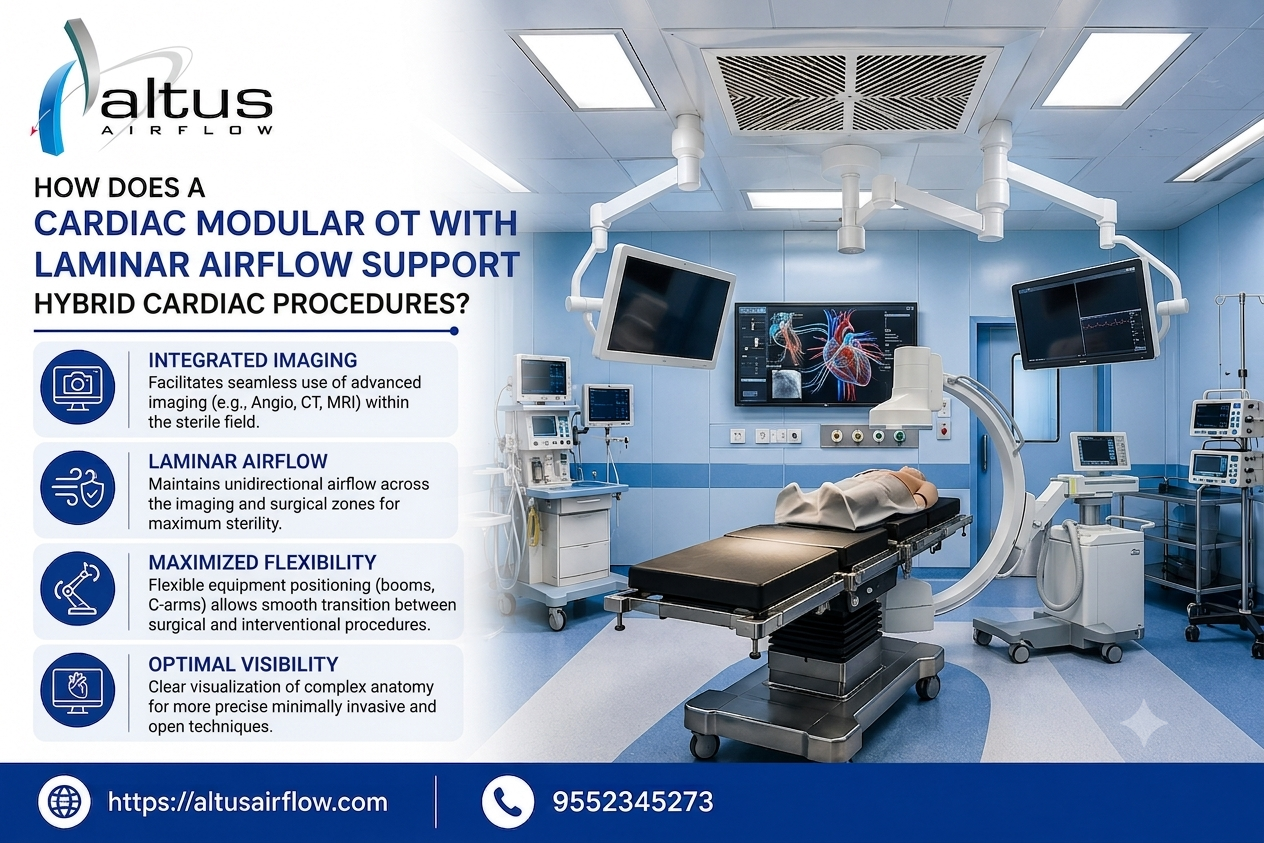
Altus Airflow develops advanced cardiac operating environments where controlled airflow, sterile surfaces, medical utilities, and surgical technology work together. A Cardiac Modular OT With Laminar Airflow can support hybrid cardiac procedures by combining a controlled sterile environment with flexible infrastructure for both surgical and image-guided interventions.
Hybrid cardiac procedures require precise coordination between surgery, imaging, anesthesia, and specialized equipment. The operating environment therefore needs appropriate airflow, space planning, equipment integration, and reliable environmental control.
Understanding Hybrid Cardiac Procedures
Hybrid cardiac procedures combine conventional surgical techniques with minimally invasive or catheter-based interventions in the same procedural environment. Instead of transferring a patient between different rooms, clinicians can perform multiple stages of treatment within one appropriately designed hybrid operating theatre.
These procedures may involve advanced imaging, cardiac surgery, vascular intervention, catheter-based treatment, or other image-guided techniques. Because different clinical teams and technologies may work simultaneously, the room must provide sufficient space, controlled environmental conditions, and well-planned equipment positioning.
A modular cardiac OT can be configured around these requirements. Laminar airflow further contributes to environmental control by delivering filtered air in a controlled pattern over the critical surgical zone.
1. Controlled Airflow for the Surgical Zone
Air quality is an important consideration during cardiac procedures because the operating environment needs to minimize airborne contamination around the patient and surgical team.
In a Cardiac Modular OT With Laminar Airflow, the airflow system can be designed to provide controlled, downward airflow over the operating area. Filtered supply air passes through an appropriately designed ceiling distribution system and moves toward lower-level return or exhaust points.
The objective is to create a cleaner zone around the operating table while managing air movement throughout the room. Proper airflow design must be supported by appropriate filtration, room sealing, air balancing, and commissioning.
2. Integration of Imaging Equipment
One of the defining characteristics of hybrid cardiac procedures is the use of advanced imaging equipment. Systems such as fixed imaging equipment, C-arm systems, or other specialized technologies can require considerable space and carefully planned movement paths.
The operating room layout should account for equipment dimensions, positioning, access requirements, ceiling-mounted systems, and the location of the operating table.
A Cardiac Modular OT With Laminar Airflow can be planned around the imaging system so that airflow distribution and equipment placement do not unnecessarily interfere with each other. Coordination between HVAC design and medical equipment planning is particularly important in such environments.
3. Flexible Space Planning
Hybrid procedures can involve multiple professionals working around the patient simultaneously. Cardiothoracic surgeons, interventional cardiologists, anesthesiologists, nurses, radiology personnel, technicians, and other specialists may require access to the operating area.
For this reason, space planning should consider not only the operating table but also equipment movement, staff circulation, emergency access, sterile zones, storage, and service areas.
Modular construction allows wall and ceiling systems, service points, and other infrastructure to be planned according to the functional requirements of the procedure room. This helps create a more organized environment without unnecessarily obstructing clinical movement.
4. Medical Gas Integration
Hybrid cardiac procedures can require multiple medical gases and dependable utility connections. Oxygen, medical air, vacuum, and other gases may be required according to the clinical application and equipment specification.
Medical gas outlets should be positioned so that clinicians can access them efficiently without creating unnecessary tubing across critical working areas.
The design of a Cardiac Modular OT With Laminar Airflow should therefore coordinate medical gas systems with surgical equipment, anesthesia systems, ceiling pendants, and the overall room layout.
Proper engineering and testing are essential to ensure that the installed system performs according to the applicable project requirements.
5. Surgical and Imaging Equipment Coordination
Hybrid cardiac rooms contain more equipment than a conventional operating theatre in many cases. Surgical lights, anesthesia equipment, operating tables, imaging systems, monitors, pendants, surgical devices, and other technologies must coexist within a limited space.
Equipment coordination should take place during the planning stage rather than after construction.
A coordinated layout can help reduce clashes between ceiling-mounted equipment and imaging systems. It can also preserve access around the operating table and support efficient movement of clinical teams.
The ceiling structure, HVAC components, electrical services, lighting, and medical gases should be considered together to create an integrated environment.
6. Maintaining Environmental Conditions
Temperature and humidity can influence staff comfort, equipment operation, and the overall operating environment. Hybrid cardiac procedures may also involve long procedural durations, making environmental stability particularly important.
The HVAC system should therefore be designed to maintain the required temperature and humidity ranges based on the applicable project specifications and healthcare requirements.
Monitoring systems can provide information about room conditions and help staff identify deviations. Automated controls may also support coordinated operation of air-handling equipment, temperature control, pressure relationships, and alarms.
Environmental control should be verified through proper testing and balancing before the room is placed into clinical service.
7. Positive Pressure and Airflow Management
Operating theatres are generally designed with appropriate pressure relationships to help control the movement of air between the operating room and adjacent spaces.
A hybrid cardiac theatre must account for door openings, personnel movement, equipment movement, and other factors that can influence room pressure.
A Cardiac Modular OT With Laminar Airflow can combine controlled supply airflow with appropriate room pressure management. However, laminar airflow alone does not establish a sterile environment. Room construction, filtration, pressure control, doors, sealing, cleaning procedures, and operational practices all contribute to infection-control performance.
8. Cleanable Modular Wall and Ceiling Systems
Hybrid cardiac procedures require an environment that can be cleaned and maintained effectively. Modular wall and ceiling systems can provide smooth, durable, and cleanable surfaces with carefully managed joints and service penetrations.
The construction should minimize areas where dust, moisture, or contaminants could accumulate. Wall panels can also be coordinated with electrical outlets, medical gas systems, communication equipment, and other services.
Ceiling systems must accommodate airflow diffusers, lighting, imaging equipment, access requirements, and maintenance provisions.
The result is an environment designed around both clinical functionality and long-term maintainability.
9. Electrical and Data Infrastructure
Hybrid cardiac procedures rely heavily on electrical and electronic systems. Imaging equipment, patient monitoring systems, surgical devices, displays, communication systems, and other technologies require dependable electrical infrastructure.
The room design should provide appropriately planned power distribution and data connectivity. Critical equipment may also require suitable backup power arrangements according to the facility's engineering requirements.
Cable management is another important consideration. Cables should be routed in a manner that reduces obstruction around the operating table and maintains orderly clinical circulation.
Coordination of electrical, HVAC, medical gas, and data systems helps reduce conflicts during installation and future maintenance.
10. Surgical Lighting and Visibility
Adequate lighting is essential for cardiac procedures. Hybrid environments may require a combination of surgical lighting, general room illumination, equipment displays, and imaging-related visual systems.
Surgical lights should be positioned to provide effective illumination while avoiding unnecessary interference with imaging equipment and other ceiling-mounted systems.
Lighting design should therefore be coordinated with the operating table, laminar airflow diffuser arrangement, ceiling services, imaging equipment, and staff movement.
Well-planned lighting can support visibility during conventional surgical stages while allowing the room to transition efficiently between different procedural requirements.
11. Supporting Rapid Clinical Transitions
One advantage of a hybrid cardiac environment is that clinicians can move between surgical and minimally invasive techniques without transferring the patient to another operating room.
This can be particularly valuable when a procedure requires a change in treatment approach or when imaging is needed to guide an intervention.
The infrastructure should support these transitions through organized equipment placement, accessible utilities, sufficient circulation space, and integrated monitoring systems.
A modular approach can make it easier to plan the room around these transitions from the beginning, ensuring that the environment supports the actual clinical workflow rather than simply accommodating equipment after installation.
12. Equipment Mounting and Ceiling Coordination
Ceiling-mounted equipment is common in advanced operating environments. Surgical lights, pendants, displays, cameras, imaging components, and other systems can compete for overhead space.
This makes ceiling coordination especially important in hybrid cardiac theatres.
The structural framework, ceiling panels, airflow diffusers, lighting systems, medical pendants, and equipment supports should be reviewed together. Proper coordination can reduce interference and make maintenance access easier.
A Cardiac Modular OT With Laminar Airflow should therefore be engineered as an integrated system rather than treating HVAC and medical equipment as separate installations.
13. Infection-Control Considerations
Hybrid cardiac procedures are performed in controlled clinical environments where infection prevention is a major consideration. Air filtration and airflow management are important components, but they form only one part of the overall infection-control strategy.
Other factors include cleanable surfaces, appropriate pressure relationships, effective room sealing, controlled personnel movement, environmental monitoring, cleaning protocols, and proper maintenance.
Laminar airflow can help establish a controlled airflow pattern over the critical zone when correctly designed and commissioned. The performance of the complete HVAC system should be verified through appropriate testing.
14. Testing and Commissioning
Before a hybrid cardiac operating theatre becomes operational, its systems should undergo appropriate testing and commissioning.
HVAC testing may include airflow measurement, air balancing, temperature and humidity verification, pressure relationship checks, filtration verification, and other project-specific performance tests.
Electrical systems, medical gases, lighting, communication systems, and equipment interfaces should also be inspected and tested.
For a Cardiac Modular OT With Laminar Airflow, commissioning is particularly important because multiple systems must work together. Documentation of test results can provide useful reference information for facility teams and future maintenance.
15. Maintenance and Long-Term Performance
The performance of a hybrid cardiac OT depends on continued maintenance after installation. Filters, HVAC components, airflow systems, pressure monitoring devices, electrical infrastructure, medical gas systems, and modular surfaces should be maintained according to appropriate schedules.
Differential pressure readings, temperature, humidity, airflow performance, and other monitored parameters can help facility teams identify changes in system performance.
Preventive maintenance can also reduce the likelihood of unexpected equipment issues. Any modification to imaging equipment or major clinical technology should be reviewed against the existing HVAC and infrastructure design to ensure that the room continues to perform appropriately.
Why Integrated Engineering Matters?
A hybrid cardiac theater involves several interconnected systems. HVAC cannot be designed independently of imaging equipment, and medical gases cannot be positioned without considering the surgical workflow.
An integrated engineering approach considers architecture, HVAC, cleanroom principles, medical gases, electrical services, lighting, equipment positioning, communication systems, and maintenance access together.
This approach can reduce coordination problems during installation and help create a room that is practical for clinicians.
The objective is not simply to install a laminar airflow system but to create a complete operating environment in which airflow, infrastructure, technology, and workflow complement one another.
Conclusion
Hybrid cardiac procedures require an operating environment capable of supporting advanced imaging, surgical intervention, multiple clinical teams, and tightly coordinated infrastructure. A Cardiac Modular OT With Laminar Airflow can support these requirements through controlled airflow, integrated HVAC, flexible modular construction, medical gas planning, electrical coordination, equipment positioning, and cleanable surfaces.
Altus Airflow focuses on developing healthcare environments where these systems are planned as an integrated solution. With appropriate design, installation, testing, commissioning, and maintenance, a hybrid cardiac OT can provide a controlled and adaptable setting for complex procedures.
Frequently Asked Questions
1. How does a Cardiac Modular OT With Laminar Airflow support hybrid cardiac procedures?
A Cardiac Modular OT With Laminar Airflow supports hybrid procedures by combining controlled airflow with flexible space planning, imaging integration, medical gases, electrical systems, and surgical infrastructure.
2. Why is laminar airflow useful in hybrid cardiac OTs?
It provides a controlled airflow pattern over the critical operating area and can help reduce airborne contamination when properly designed and maintained.
3. Can imaging equipment be integrated into a modular cardiac OT?
Yes. The room can be planned around fixed or mobile imaging equipment, provided structural, HVAC, electrical, and circulation requirements are coordinated.
4. What medical gases may be required?
Depending on the clinical application, systems may include oxygen, medical air, vacuum, and other gases specified for the facility.
5. Does laminar airflow alone prevent infections?
No. Infection prevention also depends on filtration, pressure control, room construction, cleaning, maintenance, and clinical practices .
Read Our Previous Blog ---------------> How does positive pressure work in a Cardiac Modular Operation Theatre?

eSIMcho | Global eSIM & No Roaming

 Български
 Russian