


How to Balance Print Coverage, Packaging Durability, and Budget in Gable Packaging
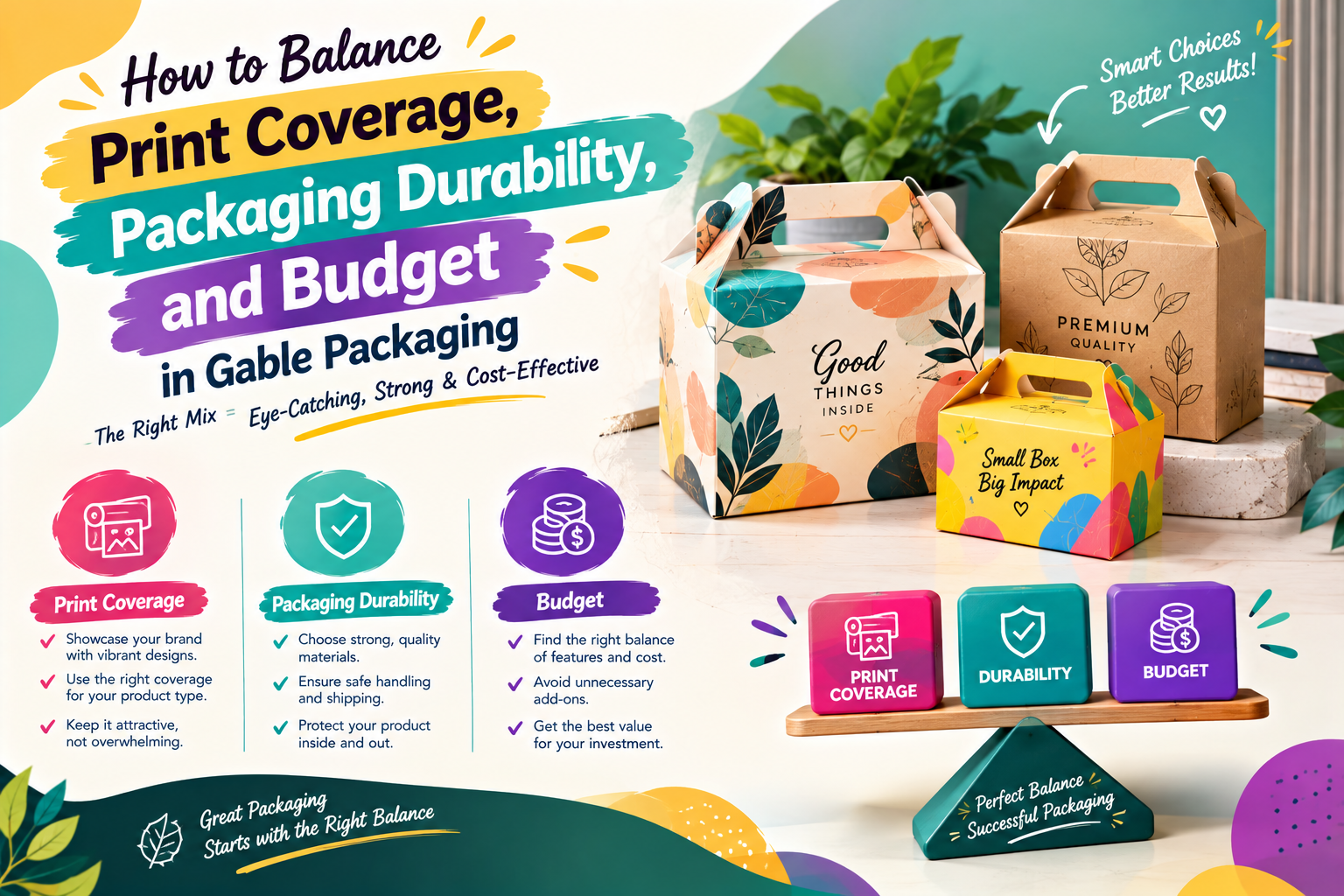
Designing effective gable packaging involves more than choosing attractive colors or selecting a sturdy material. Businesses must find the right balance between how much of the box is printed, how well the structure protects its contents, and how much the packaging costs to produce. When these elements work together, a gable box can represent a brand professionally without creating unnecessary production expenses.
The challenge is that improvements in one area can affect another. Full-surface printing may create a more distinctive appearance but increase ink coverage and finishing requirements. Thicker materials may improve rigidity while raising material costs. Meanwhile, reducing the packaging budget too aggressively can lead to weak construction or a design that fails to communicate the brand effectively.
The solution is not to spend equally on every feature. It is to identify which packaging elements provide the greatest value for the product, the customer, and the business.
Establish a Clear Priority Before Designing the Box
Before deciding how much artwork to print or which material to use, determine what the gable packaging needs to accomplish.
A box designed for lightweight promotional giveaways has different requirements from one used for bakery products, premium gifts, or heavier retail items. Each application demands a different combination of visual appeal, structural performance, and cost control.
Start by defining three priorities:
-
Print coverage: How prominently should the packaging display the brand, product information, and visual design?
-
Durability: What level of strength and protection is necessary for the product's weight and handling conditions?
-
Budget: What is the acceptable cost per box at the intended production quantity?
These priorities provide a practical foundation for making design decisions. For example, a business selling luxury gift sets may invest more in premium printing, while a company distributing thousands of promotional packages may prioritize consistent branding and efficient production.
A clear purpose prevents businesses from spending money on decorative features before the packaging's essential requirements have been addressed.
Treat Print Coverage as a Design Decision, Not a Percentage Target
Printing across every available surface does not automatically make gable packaging more attractive. In many cases, a carefully planned design with selective coverage can create a stronger visual impression than a box filled with competing graphics.
Full-coverage printing may be suitable for products that rely on bold patterns, illustrated themes, or distinctive brand imagery. However, minimal printing can work equally well when the logo, typography, and background color are carefully coordinated.
Consider a small confectionery business. Instead of printing elaborate graphics across every panel, it could use a solid brand color, a prominent logo, and a simple decorative element near the front. The result may look polished while requiring less artwork and potentially less ink.
The actual savings depend on the printing process, substrate, ink system, and production setup. Reducing printed coverage does not necessarily reduce total costs by the same percentage.
The objective should be to use print strategically, ensuring that every printed area contributes to recognition, communication, or product presentation.
Select a Material That Supports Both Print Quality and Structural Strength
The material beneath the artwork plays a major role in determining how a gable box looks and performs. A visually appealing design cannot compensate for a substrate that bends too easily, while a strong board may still produce disappointing results if it is unsuitable for the selected printing process.
Paperboard is commonly used for gable packaging because it can provide a balance of printability, foldability, and structural performance. However, the appropriate grade depends on the product's weight, box dimensions, intended use, and required protection.
When comparing material options, evaluate:
-
Board thickness and stiffness.
-
Surface smoothness and print compatibility.
-
Resistance to creasing, tearing, and routine handling.
-
Performance around the handle, base, and closure.
-
Compatibility with the intended finishing process.
-
Choosing a heavier board without assessing the complete structure can increase expenses unnecessarily. Conversely, selecting a material solely because it is inexpensive may result in a package that does not perform reliably.
The best choice is a material that meets the required strength level while producing the desired visual finish at an acceptable cost.
Concentrate Printing Where Customers Notice It Most
Not every panel of a gable box receives the same amount of attention. The front panel may be the main branding area, while the side panels, top, and back serve supporting roles.
Understanding this difference allows businesses to distribute their print budget more intelligently.
The front panel can carry the logo, product name, and primary visual element. Side panels may contain a small pattern, supporting brand information, or a secondary graphic. The back panel can accommodate instructions, contact details, or other necessary information.
The handle and upper folds also deserve special attention because artwork can become distorted or interrupted when the box is assembled.
Before finalizing the design, review a structural template or printed mockup. Check how the artwork aligns across folds and whether important details remain visible after assembly.
A thoughtful layout can create a cohesive appearance without requiring the same level of visual complexity on every surface.
Understand the Relationship Between Ink Coverage and Production Cost
Print coverage can influence material consumption and production requirements, but the relationship is more complex than simply counting colored areas.
Depending on the printing method, expenses may include plate preparation, digital setup, ink consumption, machine time, finishing, and quality control. Some costs remain relatively fixed regardless of how much of the surface is printed.
For example, a large solid background may require more ink than a design using a white or unprinted background. Yet switching to a simpler design may produce only a modest overall saving if setup and finishing account for a substantial portion of the production cost.
Businesses should request quotations based on actual artwork and specifications rather than assuming that lower ink coverage will always deliver major savings.
It is also useful to compare multiple design concepts at the same box dimensions and production quantity. This makes it easier to identify whether a more elaborate design provides enough additional value to justify its cost.
Strengthen the Areas That Carry the Most Stress
Packaging durability depends on more than the overall thickness of the board. The shape of the box, the position of its folds, and the construction of its handle and base all influence performance.
Gable boxes have a distinctive top structure with an integrated carrying handle. When a customer lifts the package, the handle and its attachment points experience stress. The bottom panel must also support the contents without excessive bending.
For this reason, durability improvements should focus on the areas that need them most.
Depending on the design, useful measures may include:
-
Selecting a suitable board grade for the intended load.
-
Refining the handle geometry and locking mechanism.
-
Designing an adequately supportive base.
-
Adjusting the dimensions to reduce unnecessary material stress.
-
Adding inserts when products need extra stability or separation.
These measures can often deliver more practical value than increasing material thickness across the entire box without a clear structural reason.
However, the complete package must still be tested. Strengthening one area does not guarantee that every other component will perform adequately.
Avoid Decorative Finishes That Complicate the Budget
Premium finishes can give gable packaging a distinctive appearance, but each additional process needs to justify its expense.
Foil stamping, embossing, debossing, specialty coatings, and selective gloss may be appropriate for luxury gifts, boutique products, or limited-edition collections. They can also increase production costs, depending on the chosen process, order quantity, and material.
For businesses working with tighter budgets, a well-designed printed surface may provide sufficient visual appeal without additional finishing.
A practical strategy is to select one distinctive feature instead of combining several expensive effects. For instance, a business could use a restrained color palette with a small foil-stamped logo rather than applying metallic effects across multiple panels.
The key is to connect the finish to the product's positioning. If customers are unlikely to notice or appreciate the added detail, the extra expense may be better invested in stronger materials or improved packaging functionality.
Calculate the Real Cost Per Box Before Approving Production
A packaging quotation can appear affordable until additional expenses are included. Material, printing, cutting, creasing, gluing, finishing, transportation, storage, and assembly can all contribute to the final cost.
Businesses should therefore evaluate the complete production cost instead of comparing material prices alone.
A useful calculation is:
Total packaging cost per unit = Total packaging-related production cost ÷ Number of acceptable finished boxes.
For example, suppose a business spends $2,000 producing 5,000 acceptable gable boxes. Its average production cost is $0.40 per box.
If a revised design costs $2,200 for the same number of acceptable boxes, the cost rises to $0.44 per box. That additional $0.04 may be worthwhile if the revised package provides a meaningful improvement in durability or brand presentation.
These figures are illustrative rather than market quotations. Actual costs vary by location, supplier, material specification, printing process, and order quantity.
Including rejected or unusable boxes in the evaluation is also important. A cheaper design that produces more defects may become less economical than a slightly more expensive option with better manufacturing consistency.
Choose Print Technology According to Volume and Design Complexity
The printing method can influence both the appearance and economics of gable packaging.
Digital printing may be attractive for short runs, personalized designs, and campaigns that require multiple artwork variations. Conventional production methods, such as offset printing, may become more economical for larger runs, depending on setup costs, specifications, and supplier capabilities.
Neither method is universally cheaper.
A small business producing seasonal gift boxes may value the flexibility of digital printing, even if the unit price is higher. A large retailer ordering the same design in substantial quantities may benefit from a process with higher initial setup costs but a lower unit cost at scale.
Businesses should compare quotations using the same artwork, material, dimensions, and finishing requirements. They should also consider minimum order quantities, lead times, color consistency, and the cost of future reprints.
Selecting the printing process early helps avoid designing a package that is visually impressive but unnecessarily expensive to manufacture.
Reduce Material Waste Through Smarter Box Dimensions
Packaging dimensions influence material consumption, storage, and transportation. A box that is unnecessarily large may require more board, leave excessive empty space, and increase the need for protective inserts.
An undersized box can create a different problem by placing pressure on the contents or making assembly difficult.
The goal is to find dimensions that accommodate the product comfortably while supporting efficient material use.
Start by measuring the product and allowing sufficient clearance for insertion, removal, and any protective components. Consider how the box folds from a flat template and whether the dimensions can be adjusted to improve material utilization during cutting.
Standardized sizes may also help businesses simplify inventory when several products can share the same packaging format.
However, standardization should not compromise product fit or structural reliability. A slightly customized size may offer better overall value if it significantly reduces unused space or improves protection.
Make Sample Testing Part of the Budget Strategy
A packaging sample provides an opportunity to identify problems before committing to a full production run.
Even a carefully prepared digital design may not reveal how the material behaves when folded, how colors appear on the actual substrate, or whether the handle remains comfortable and secure during use.
A useful testing process should examine three areas.
- Print performance: Check color consistency, logo clarity, artwork alignment, and the appearance of folds and edges.
- Structural performance: Assess the base, handle, closures, and overall shape using the intended product and expected load.
- Cost performance: Compare the sample's specifications with the production quotation and identify features that could be simplified without compromising essential requirements.
For products that will be transported, testing should reflect the expected handling and distribution conditions. For food-related packaging, material suitability and applicable food-contact requirements must also be considered.
A sample may involve an additional upfront expense, but it can help prevent larger losses caused by unsuitable materials, printing defects, or structural failures.
Build a Repeatable Packaging System Instead of Redesigning Every Order
Businesses can often control packaging costs more effectively by developing a consistent design system.
Rather than creating a completely new gable box for every product or campaign, establish a core visual identity that includes standard logo placement, typography, brand colors, and structural specifications.
Individual versions can then be adapted through selected changes, such as a different accent color, product label, or seasonal graphic.
This approach can reduce repeated design work and simplify artwork approval. It may also make it easier to reuse established production specifications across future orders.
The system should remain flexible enough to accommodate products with different weights, dimensions, or protection requirements. A shared visual identity does not mean every product must use an identical structure.
By separating essential design standards from optional decorative elements, businesses can preserve brand consistency while keeping packaging decisions manageable.
Use a Practical Framework to Balance All Three Priorities
The most effective way to manage print coverage, durability, and budget is to evaluate them together instead of making isolated decisions.
A simple framework can help:
First, establish the minimum performance requirements. Determine the necessary strength, product fit, handle performance, and material suitability before choosing decorative upgrades.
Second, define the visual essentials. Identify the logo, product information, brand colors, and graphics that genuinely need to appear on the package.
Third, compare optional improvements. Evaluate premium finishes, expanded print coverage, inserts, and specialized materials according to their actual benefits.
Fourth, test the complete design. Use a physical sample to assess appearance, usability, and structural performance.
Finally, compare the total cost of acceptable finished units. Consider manufacturing consistency, waste, and any additional packaging components required.
This order helps protect the product first, maintain a recognizable brand presentation, and control unnecessary spending without sacrificing important features.
Final Thoughts: Make Every Packaging Decision Earn Its Cost
Balancing print coverage, packaging durability, and budget in gable packaging requires a clear understanding of what the box needs to achieve.
Extensive printing can help a product stand out, but thoughtful artwork placement may create a similarly strong impression with less visual complexity. A stronger board can improve performance, but structural design and material selection should determine where additional strength is necessary. Meanwhile, cost reductions are most useful when they preserve quality rather than simply lowering the initial quotation.
Businesses should begin with product requirements, identify the most valuable branding elements, and compare material and printing options using realistic production figures.
Ultimately, successful gable packaging is not defined by the amount of ink, the thickness of the board, or the number of premium finishes. It is defined by how effectively the package protects the product, communicates the brand, and delivers reliable performance at a sustainable cost.
When every design choice serves a clear purpose, businesses can create packaging that looks professional, performs consistently, and makes better use of their budget.
Place Your Order Now at Ibex Packaging: https://ibexpackaging.com/gable-boxes/

eSIMcho | Global eSIM & No Roaming

 Български
 Russian